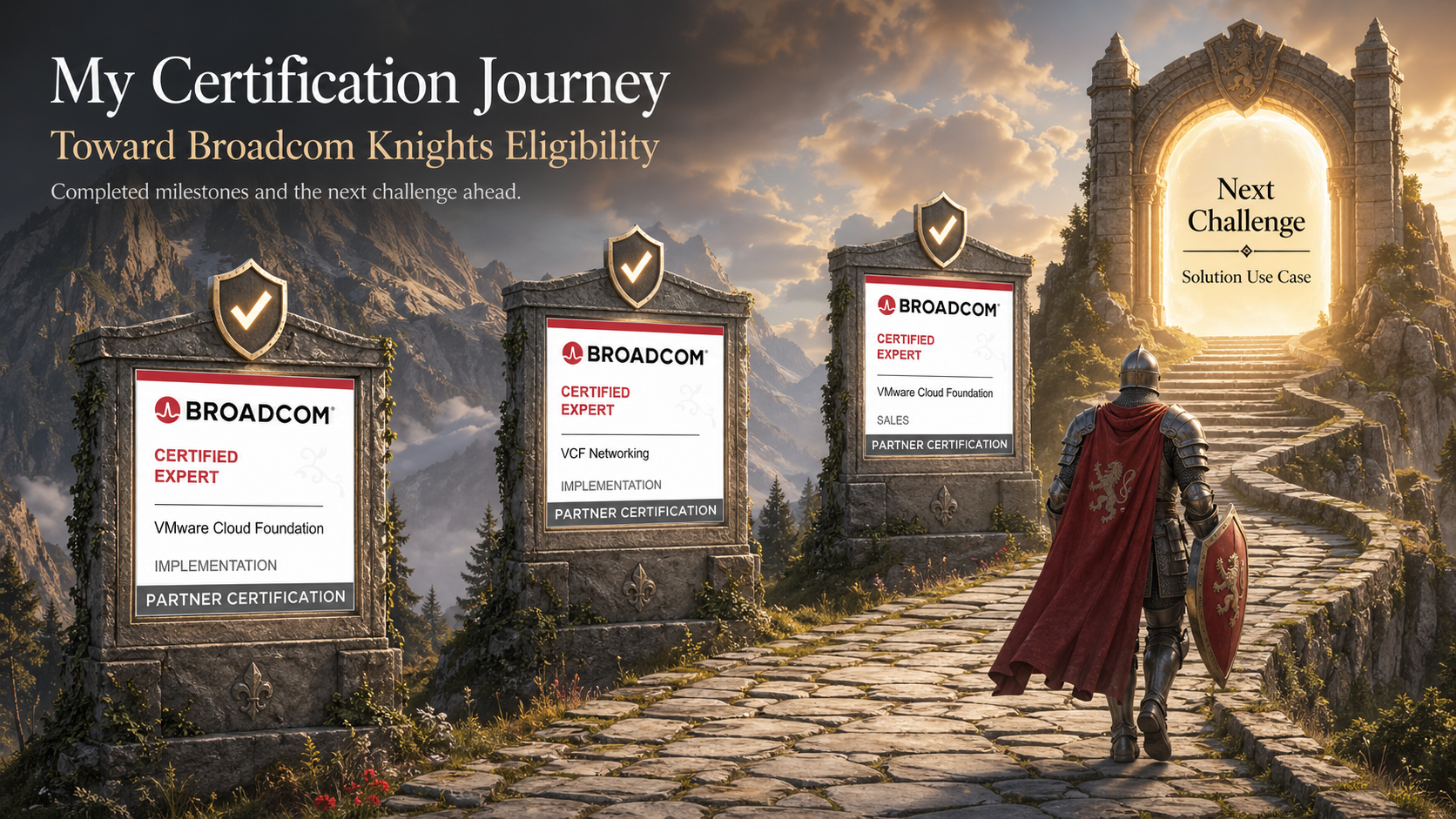
August 2026 update: Since publishing this article, I completed the remaining requirements and was selected for the Broadcom Knights program. What began as a certification goal has become an opportunity to contribute, learn alongside other VCF experts, and represent ClearBridge within the broader Broadcom technical community.
Overview #
Over the past year, I have been working through a certification journey tied directly to the work I have been doing in the field with VMware Cloud Foundation.
This journey has not just been about earning badges. It has been about building proof of capability across the areas that matter when supporting real customers: platform implementation, networking implementation, and the ability to connect VCF to customer goals and business outcomes.
For me, that work has been closely tied to supporting a Navy customer through a major VCF modernization effort, moving from an existing VCF 5.2 environment toward a greenfield VCF 9 deployment and then continuing into day two operations, networking, automation, security, and platform expansion.
The VCF Sales Certified Expert Partner Certification completed the original path into Broadcom Knights. Since then, I have also earned VMware Certified Advanced Professional credentials in VCF Networking, VCF VKS, and VCF Automation—milestones that track directly with the architecture and delivery work I continue to do in the field.
Why This Path Matters #
Broadcom Knights represents one of the highest levels of recognition for partner individuals within the Broadcom ecosystem. It is not just about passing one exam or completing one course. The path requires a combination of certifications, demonstrated experience, customer impact, and continued engagement.
For VMware Cloud Foundation, the journey includes multiple areas of capability. There is the sales and business value side, the platform technical side, the component technical side, and the Solution Use Case requirement.
That structure makes sense to me because VCF is not a single product conversation. It is a platform conversation.
A strong VCF professional needs to understand how to deploy and support the platform, how networking and security decisions affect the design, how operations and automation fit into the larger picture, and how to explain the value of the platform in a way that connects with the customer.
That is what made this journey valuable.
The Certified Expert Milestones #
At this point, I have completed three Certified Expert milestones that align to the areas I have been focused on.
VMware Cloud Foundation Implementation #
The VCF Implementation Certified Expert milestone aligned closely with the core platform work I have been doing in the field.
The customer engagement started with discovery around an existing VCF 5.2 environment. After reviewing the current state, operational gaps, lifecycle limitations, and future requirements, the path shifted toward a greenfield VCF 9 deployment.
That work included:
- evaluating the existing VCF 5.2 environment
- preparing the modernization path to VCF 9
- remediating and rebuilding hosts
- installing ESXi 9
- deploying the VCF 9 Installer appliance
- bringing up the Management Domain
- commissioning hosts
- deploying the Workload Domain
- validating vCenter, NSX, and core platform communication
- stabilizing the environment for future expansion
This was the foundation of the journey.
The implementation work showed the importance of understanding the platform from the ground up. VCF is not just a collection of products. It is an integrated private cloud platform where each layer depends on the health and design of the layers beneath it.
VCF Networking Implementation #
The VCF Networking Certified Expert milestone was tied to the NSX and networking side of the engagement.
This part of the work focused on building and validating the network foundation needed for the platform to operate correctly. In a secure environment, networking decisions become even more important because there are often strict constraints around routing, firewall rules, NAT, access paths, and change control.
The networking work included:
- designing the NSX Tier 0 architecture
- deploying and configuring NSX Edge nodes
- validating north south connectivity
- configuring Tier 0 uplinks
- aligning IP addressing with the upstream physical network
- supporting VLAN backed and overlay networking
- validating Edge node health
- coordinating firewall dependencies
- supporting no NAT design requirements
- preparing networking for Supervisor and automation workloads
This was also where day two troubleshooting became a major part of the evidence.
Some of the most valuable experience came from solving real issues. That included DNS and NTP issues affecting NSX Edge upgrades, firewall dependencies impacting NSX lifecycle operations, and image compliance problems tied to NSX VIB installation.
The networking work reinforced something I have learned repeatedly in the field: if the network design is not right, the platform will eventually expose it.
VCF Automation, Supervisor, Kubernetes workloads, VM Apps, and All Apps all depend on a clean network foundation. That made the networking milestone especially meaningful.
VMware Cloud Foundation Sales #
The VCF Sales Certified Expert milestone was different from the technical paths.
The sales track started with passing the VCF Sales assessment to achieve the Proven Professional certification. That Proven Professional certification was a prerequisite before moving into the Sales Certified Expert path.
From there, I completed the VCF Sales Simulation, which resulted in the Sales Certified Expert certification.
What made this track valuable was that it focused on customer conversations, business challenges, stakeholder roles, and how VMware Cloud Foundation can help solve real problems.
That matters because VCF is not only a technical conversation.
A customer may care about lifecycle management, automation, security, cost visibility, modernization, operational consistency, or reducing complexity. Different stakeholders care about different outcomes. A technical lead may focus on architecture and implementation. A security stakeholder may focus on compliance and control. Leadership may care more about cost, risk, and the ability to deliver services faster.
The sales track helped reinforce the importance of translating technical capability into customer value.
That is something I use in the field constantly.
How I Built the Evidence #
The Certified Expert paths required me to organize my field experience into evidence that showed what I had actually done.
For the VCF Implementation and VCF Networking Certified Expert submissions, I treated the evidence like a professional statement of work. I wanted the evidence to be clear, structured, and tied to real delivery.
The structure included:
- overview of the engagement
- requirements
- assumptions
- constraints and risks
- out of scope items
- deployment activities
- timeline
- success criteria
- bill of materials
That format helped me explain the work in a way that was easy to follow.
For the implementation evidence, I focused on the full VCF platform journey. That included the move from the existing VCF 5.2 environment into the VCF 9 deployment, the Management Domain, Workload Domain, host remediation, NSX deployment, platform validation, and operational readiness.
For the networking evidence, I focused on NSX design and implementation. That included Tier 0 design, Edge deployment, routing, segmentation, IP addressing, no NAT design requirements, Supervisor networking support, and day two troubleshooting.
For the day two implementation evidence, I included the continued work after the initial deployment. That included upgrades to VCF 9.0.2, lifecycle remediation, high side deployment support, VCF Operations dashboards, DISA compliance visibility, Health and Security Toolkit work, STIG tooling, identity and CAC troubleshooting, VCF Automation design, ServiceNow integration planning, and cost modeling.
That broader day two work mattered because it showed the platform being used and expanded in a real customer environment, not just deployed once and handed off.
Field Work Behind the Certifications #
The strongest part of this journey has been that the certifications were connected to real work.
This was not lab only experience.
The customer environment required practical problem solving across multiple areas of VCF, including:
- lifecycle management
- NSX troubleshooting
- firewall coordination
- DNS and NTP validation
- high side deployment constraints
- security and compliance reporting
- identity and authentication troubleshooting
- VCF Operations visibility
- automation planning
- ServiceNow integration planning
- Supervisor and workload networking design
That is where the certifications started to feel less like standalone achievements and more like validation of the work already happening in the field.
The platform implementation milestone connected to the core VCF deployment.
The networking milestone connected to NSX and the network foundation.
The sales milestone connected to customer communication, business outcomes, and explaining why the platform matters.
Together, they represent a more complete view of what VCF delivery requires.
What I Learned #
The biggest takeaway from this journey is that VCF requires range.
It is not enough to only understand the installer. It is not enough to only understand NSX. It is not enough to only understand the customer pitch.
You need to understand how all of it connects.
A VCF implementation can be technically correct but still struggle if the networking is not aligned. An automation design can look good on paper but fail if DNS, certificates, identity, or IP space are not planned correctly. A technical solution can be strong but still miss the mark if it is not connected to the customer’s goals.
That is what this journey has reinforced for me.
Good VCF delivery requires technical depth, operational awareness, customer communication, and the ability to keep moving when the environment does not behave exactly like the documentation.
That is especially true in secure federal environments where access, change control, and network constraints can make every step more complex.
Selected for Broadcom Knights #
Since originally documenting this journey, I completed the remaining requirements and was selected for the Broadcom Knights program.
The recognition is meaningful because it reflects more than a collection of certifications. It represents the field experience, customer outcomes, continued learning, and community involvement behind them. It also gives me the opportunity to learn alongside some of the strongest architects in the VCF community and bring that knowledge back to the customers and consultants I support.
My focus now is continuing to deepen my expertise across VCF automation, operations, networking, Kubernetes, and architecture while helping others build their own paths through the platform.
Final Thoughts #
This journey has been a long one, but it has been worth it.
The certifications matter, but the field experience behind them matters more.
Supporting a customer through a VCF modernization effort, moving from VCF 5.2 to VCF 9, working through NSX design, lifecycle issues, security tooling, operations visibility, automation planning, and customer conversations has made the certification path feel practical and relevant.
Becoming a Broadcom VCF Knight is an important milestone, but it is not the finish line. The next phase is continuing to grow as both an architect and a Practice Manager, helping customers modernize successfully and helping other consultants build the experience and confidence to lead complex VCF engagements.